Hi there.
First of all, this is my first post after two years. I am not gonna post something about flight data recorder as my previous post. Instead, I would like to share with you, another interesting topic in airline industry.
Many aviation-related-companies in this world offer an aircraft valuation services. For a specific condition of aircraft and in a particular time reference, they would provide you with -let me say an opinion from certified person about what the dollar value of your aircraft(s) should be, in worldwide market.
An opinion from certified appraisers is of course a very important reference for insurance broker and aircraft owner. Insurance broker calculates what amount of risk premium that airline shall bear to insure the aircraft. This premium is basically depend on the aircraft value. An aircraft owner use the opinion to determine how much dollar money shall the airline (who operates his/her aircraft) pay to him/her should there is total loss involving the aircraft.
Okay, I am gonna stop the introduction. What I am gonna share with you is a -well, at least based on my experiences, method and formula on how to fairly calculate an aircraft value. In this example, I would like to value an Boeing 737 aircraft in its middle age of economic life (had done airframe and engine heavy maintenance). Let us assume that this aircraft is under MSG-2 block-check maintenance.
Valuation would be divided into two main parts. First, calculation of a so called adjusted value due to maintenance status. A non certified person could do this step. Second, final calculation involving an economic-based estimation of aircraft and engine half-life value which should only be done by certified and experienced person or entity.
Adjusted valuation due to maintenance status of an aircraft would require the following cost information:
- Last D-Check date, time since Last D-Check, and its maintenance interval
- Last landing gear overhaul date, time since last overhaul, and its maintenance interval
- Last engine refurbishment date, time since last refurbishment, and its shop-visit interval estimate
- Last LLP replacement date (for each LLP module), time since last replacement, and its replacement interval
- Last APU overhaul date, time since last overhaul, and its shop-visit interval estimate
In addition, one would also need the following aircraft and engine maintenance status:
- Total cost of D-Check
- Landing gear overhaul cost
- Engine refurbishment cost (refurbishment to engine full EGT margin)
- Engine LLP replacement cost
- APU Overhaul cost
 |
| Maintenance status and cost information. Numbers are for illustrative only. |
 |
| Engine LLP status and cost information. Numbers are for illustrative only. |
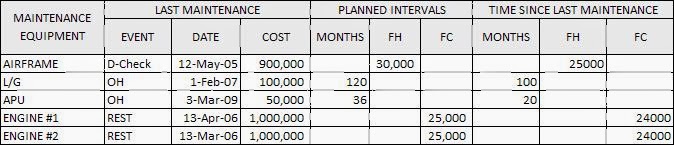
From the first table above, the airframe last D-Check was on March 2005 and it costs $900,000. Aircraft flight hours was used as timer for this D-Check maintenance and its interval is 30,000 flight hours and until the calculation was prepared, the aircraft had been flying for 25,000 flight hours. The landing gear was overhauled on January 2007 and it costs $100,000. The interval is 120 calendar months and had been used for 100 months.
APU was overhauled on February 2009 and costs $50,000. The interval was estimated for 36 months and had been used for 20 months. Two engines was refurbished concurrently on May 2006 and cost $1,000,000 for each engine. The interval was estimated for 25,000 flight cycle and had been used for 24,000. The second table was used to calculate adjustment value for LLP of engines.
If you observe the usage of the parts mentioned above, you may notice that most of the maintenance had been 'used' by more than half of its economic life, except the D-Check which still have 25,000 of 30,000 flight hours remains. This lead us to an assumption that the adjusted value would be relatively low compared to its full maintenance value.
Now, for the formula. The adjusted value for each parts should be a fraction of its remaining maintenance value to its full maintenance value, multiplied by maintenance cost, i.e.:
AV = (0.5 - (Time Since Last Mtx / Mtx Interval)) * Mtx Cost
Formula above was self-explanatory. If the aircraft was fresh from D-Check, then time since last maintenance would zero and its adjusted value would be equal to half of its maintenance cost. Or if the engine EGT margin would go negative in a few days of flight, then its maintenance fraction would be almost equal to minus zero point five (for example: 0.5 - 24,990/25,000) and makes it trash of aluminium!
Using the two tables above and calculating the adjusted value by formula already mentioned, then one would arrive at -$545,800 of adjusted value. This negative dollar value had been guessed earlier, as most of parts had been used for more than half of its economic life. For clarity, I share your my excel calculation
here.
Now that the adjusted value obtained, the final step is required. A good definition of half-life value of an aircraft is given by ISTAT,
'Half-life' condition assumes that every component or maintenance service which has a prescribed interval that determines its service life, overhaul interval or interval between maintenance services, is at a condition which is one-half of the total interval.
In general, half-life value of an aircraft was dependent on aircraft age, aircraft type, and aircraft maximum take-off weight. Assuming that one of those certified appraiser state that half-life value of the Boeing 737 aircraft with its age and characteristic is $5,000,000, then our final aircraft value would be $5,000,000 + (-$545,800) or equal to $4,454,200. End.
Dear readers, I would be very much thankful should you have time to give me feedback on my thoughts or would like to drop any comments. See you on another interesting topic on aviation.